In the competitive landscape of 2026, the mantra “Your data is a gold mine” has evolved into a fundamental business requirement. For modern organizations, the challenge is no longer just collecting data, but activating it. Valuable insights remain trapped within massive volumes of unstructured information. From complex multi-vendor contracts to global supply chain invoices and nuanced customer sentiment in emails, businesses are processing data at a scale that exceeds human capacity. The rising cost of manual intervention and the risk of data silos underscore a critical need for advanced intelligent automation.
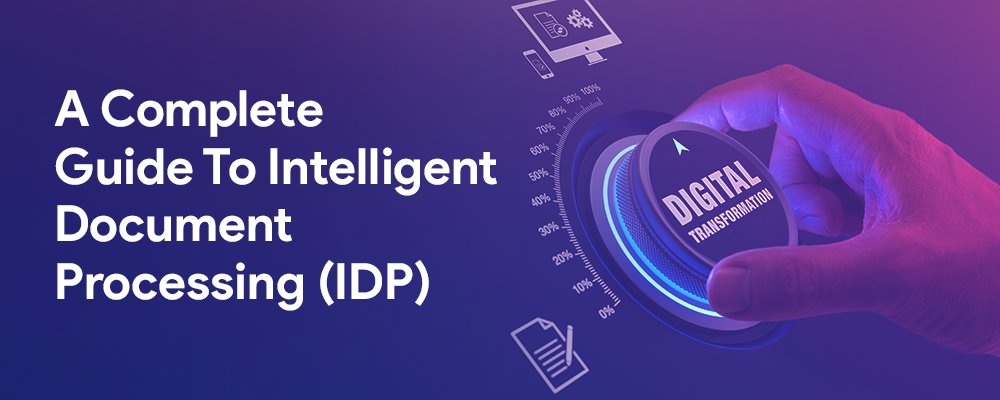
This is where Intelligent Document Processing (IDP) serves as the bridge between raw information and strategic action. In 2026, IDP has moved beyond basic automation; it now leverages Generative AI and agentic workflows to unlock the full potential of your documents, driving enterprise-wide efficiency and enabling hyper-accurate decision-making with minimal friction.
Intelligent Document Processing (IDP) is an advanced ecosystem designed to automate the capture, interpretation, and processing of information from any document source. Unlike the rigid systems of the past, contemporary IDP utilizes a sophisticated stack of Artificial Intelligence (AI), Machine Learning (ML), and Large Language Models (LLMs) to understand context, sentiment, and intent. This allows the system to convert unstructured or semi-structured data into high-fidelity, structured insights that integrate directly into your core business architecture, fostering unprecedented operational agility.
Historically, high-volume document management forced a compromise: either scale up administrative costs or accept the errors inherent in manual entry. The rapid maturation of AI has rendered that trade-off obsolete. IDP represents a generational leap over traditional Optical Character Recognition (OCR), moving into the realm of cognitive understanding. It effortlessly handles diverse formats—including dynamic PDFs, encrypted emails, handwritten logistics notes, and global tax documents—transforming them into usable digital assets. This capability allows enterprises to achieve near-total automation of data entry, significantly lowering the total cost of ownership (TCO) for business processes.
- Key Technologies Powering IDP in 2026
The efficacy of modern IDP is driven by the convergence of several cutting-edge technologies. These elements work in a unified pipeline to transform raw pixels and text into business intelligence:
- Generative AI & LLMs: Provides the reasoning layer to understand complex legal language, summarize lengthy reports, and handle document variety without specific templates.
- Machine Learning (ML): Self-optimizing algorithms that improve extraction precision by learning from edge cases and user corrections.
- Advanced OCR & ICR: High-precision engines that convert even the most challenging handwriting or degraded scans into machine-readable text.
- Computer Vision: Enables the system to perceive document structure, identifying the relationship between visual elements like tables, signatures, and logos.
- Natural Language Processing (NLP): Essential for detecting semantic meaning, allowing the system to distinguish between a billing address and a shipping address based on context.
- Agentic Workflows: AI agents that can autonomously navigate between different software systems to validate data or trigger follow-up actions.
- The 2026 Frontier: Generative IDP and Reasoning
As we move through 2026, the most significant shift in IDP is the move from “extraction” to “reasoning.” While older systems were trained to find a date or a total amount, modern Generative IDP can answer complex questions about a document. For instance, an IDP system can now review a 50-page contract and immediately flag whether the liability clauses align with the company’s updated risk management policy.
This “Cognitive Extraction” allows businesses to automate much more than just data entry. It enables automated compliance auditing, proactive risk detection, and instant cross-referencing across entire document libraries. By combining LLMs with traditional IDP, organizations are achieving a level of “Zero-Touch” processing where the vast majority of documents move from ingestion to final ERP entry without any human looking at them, maintaining 99.9% accuracy through automated self-validation loops.
- Core Capabilities and Strategic Benefits
Implementing a modern IDP solution offers a suite of capabilities that redefine information management:
- Context-Aware Extraction: Leveraging AI to interpret semi-structured documents regardless of layout. It understands the “why” behind the data, ensuring accuracy even in non-standardized formats.
- Automated Multi-Channel Ingestion: IDP automatically categorizes documents from every possible source—API feeds, cloud storage, mobile uploads, and legacy email threads—ensuring a unified stream of information.
- Cognitive Validation: The system doesn’t just check if a field is filled; it cross-references the data against global databases, historical records, and business logic to ensure it makes sense.
- Scalable Hyper-Automation: IDP serves as the “eyes” for your broader automation strategy, feeding clean, structured data into RPA bots and analytical dashboards.
- Enhanced Compliance and ESG Reporting: Automated trails ensure every document is accounted for, while AI models can be tuned to specifically track and extract data required for environmental, social, and governance (ESG) reporting.
- Maximizing Potential through Managed Services
While the technology is powerful, the true value of IDP is realized through expert orchestration. In 2026, successful implementation requires more than just software; it requires a deep understanding of process re-engineering and continuous model tuning. As document types evolve and global regulations change, IDP models must be refined to stay accurate.
For many enterprises, particularly those managing complex shared services or global supply chains, partnering with a specialized managed services provider is the most efficient path to ROI. These partners provide the technical infrastructure and the operational oversight needed to manage “Human-in-the-Loop” exceptions, ensuring that the automation remains resilient and compliant. By integrating IDP into a managed service framework, businesses can focus on their core strategic goals while their data transformation remains seamless, secure, and infinitely scalable.